- 您現(xiàn)在的位置:買賣IC網(wǎng) > PDF目錄366619 > C486CD52 10 to 4 line priority encoder PDF資料下載
參數(shù)資料
| 型號: | C486CD52 |
| 英文描述: | 10 to 4 line priority encoder |
| 中文描述: | 電信提供商/數(shù)據(jù)通信 |
| 文件頁數(shù): | 1/15頁 |
| 文件大小: | 426K |
| 代理商: | C486CD52 |
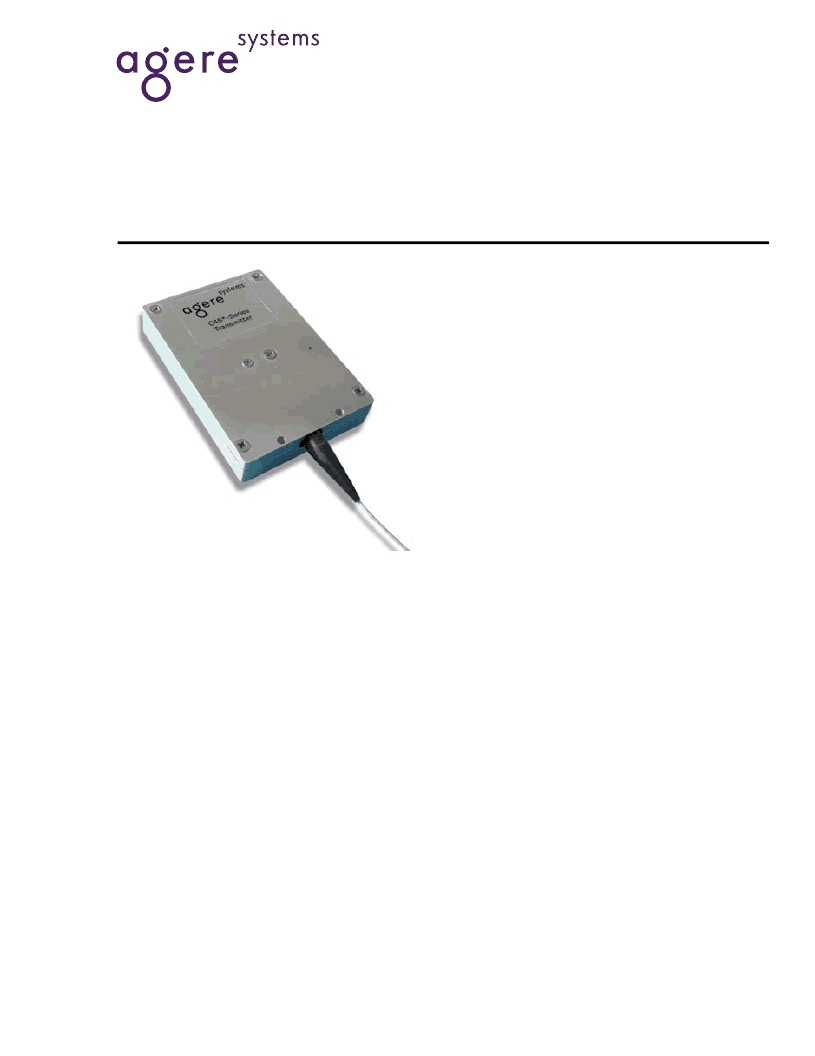
C482, C484, and C486 (C48-Type)
2.5 Gbits/s Cooled Laser Transmitters
Data Sheet, Rev. 1
September 2002
Offering multiple output power options and SONET/SDH com-
patibility, the C48-Type 2.5 Gbits/s Cooled Laser Transmitters
are manufactured in a 24-pin plastic DIP with a single-mode
fiber pigtail.
Features
■
Data rates to 2.5 Gbits/s
■
Two-channel selectable at 100 GHz spacing
■
SONET and ITU-T compliant at OC-48 and
STM-16
■
Cooled, InGaAsP MQW-DFB laser
■
Wavelength range, 1528.77 nm—1563.86 nm
■
User-selectable wavelengths
■
Clocked or nonclocked operation with single-ended
inputs; clocked operation with differential input
■
50
ac-coupled PECL compatible data and clock
inputs
■
Operation from 3.3 V and 5 V power supplies
■
Low-profile, 24-pin package
■
Automatic optical power control
■
Wide operating case temperature range,
–15 °C to +70 °C
■
Laser bias monitor alarm/laser degrade alarm
■
Laser back-facet monitor output
■
Transmitter-enable input
■
FC/PC or SC/PC connectors
Applications
■
Telecommunications:
— SONET/SDH SR/IR/LR
— Subscriber loop
— Metropolitan area networks
■
High-speed data communications
Description
The C48-type 2.5 Gbits/s cooled laser transmitters
are designed for use in transmission systems and
high-speed data communication applications. The
transmitter operates at the SONET OC-48 rate, as
well as the ITU-T SDH rate of STM-16. The device
supports two wavelengths. The second wavelength
is selectable via pin 10.
The transmitters meet all present
Telcordia Technol-
ogies
TM
GR-253-CORE requirements and the ITU-T
G.957 and G.958 recommendations. They are also
ideally suited for extended-distance data and net-
working applications.
Manufactured in a 24-pin DIP, the transmitter incor-
porates a hermetic multiquantum well (MQW) iso-
lated 1550 nm digital distributed feedback (DFB)
laser (D2526 versions), an InGaAs PIN photodiode
back-facet monitor, and a GaAs laser driver IC. The
unit uses two power supplies. The laser transmitter
requires 5 V, and the thermoelectric cooler (TEC)
requires 3.3 V. The clock may be enabled for those
applications where jitter is critical.
Pin information is listed in Table 1.
相關(guān)PDF資料 |
PDF描述 |
|---|---|
| C486CD53 | 8 to 3 line priority encoder |
| C486CD54 | 8 to 3 line priority encoder |
| C486CD55 | 8 channel multiplexer |
| C486CD56 | 8 channel multiplexer |
| C486CD57 | Dual 4 channel multiplexer |
相關(guān)代理商/技術(shù)參數(shù) |
參數(shù)描述 |
|---|---|
| C486YD22J | 制造商:CYOPTICS 功能描述: |
| C48719-000 | 制造商:TE Connectivity 功能描述:22759/33-24-96CS2621 - Cable Rools/Shrink Tubing |
| C4877 | 制造商:HAMAMATSU 制造商全稱:Hamamatsu Corporation 功能描述:High Performance Thermoelectric Coolers |
| C4878 | 制造商:HAMAMATSU 制造商全稱:Hamamatsu Corporation 功能描述:High Performance Thermoelectric Coolers |
| C488 | 制造商:Datak Corporation 功能描述: |
發(fā)布緊急采購,3分鐘左右您將得到回復(fù)。